Ideas ·
Why Kids Need More to Own
Ownership isn't about having more. It's about becoming the person who notices, prepares, improves, and cares for something over time.

Childhood has a new default: consumption.
Not just toys. Videos. Lessons. Activities. Experiences. Recommendations. Even many childhood interests arrive neatly packaged with the right gear, the right accessories, and the right way to participate.
This isn’t a criticism of parents. It’s the world we’ve built around children: convenient, abundant, thoughtfully organized, and remarkably good at delivering the next thing.
But receiving isn’t the same as participating.
Participation asks something of a child.
It asks them to notice.
To prepare.
To make decisions.
To care for something.
To come back tomorrow.
That’s where ownership begins.
A child who loves birds can watch videos all afternoon. A child who keeps the bird feeder full, notices when the goldfinches return, and wonders why they disappeared for a week is building a relationship with the natural world.
A child fascinated by golf isn’t just playing a sport. She can clean her clubs, keep her bag organized, replace worn tees, track what she’s practicing, and decide what deserves attention before the next round.
A child who loves cooking doesn’t just bake cookies. He learns where ingredients belong, sharpens his eye for a good tomato, notices the pantry running low on flour, and prepares the kitchen for whoever cooks next.
None of these children own their interest because of what they have.
They own it because they’re participating in it.
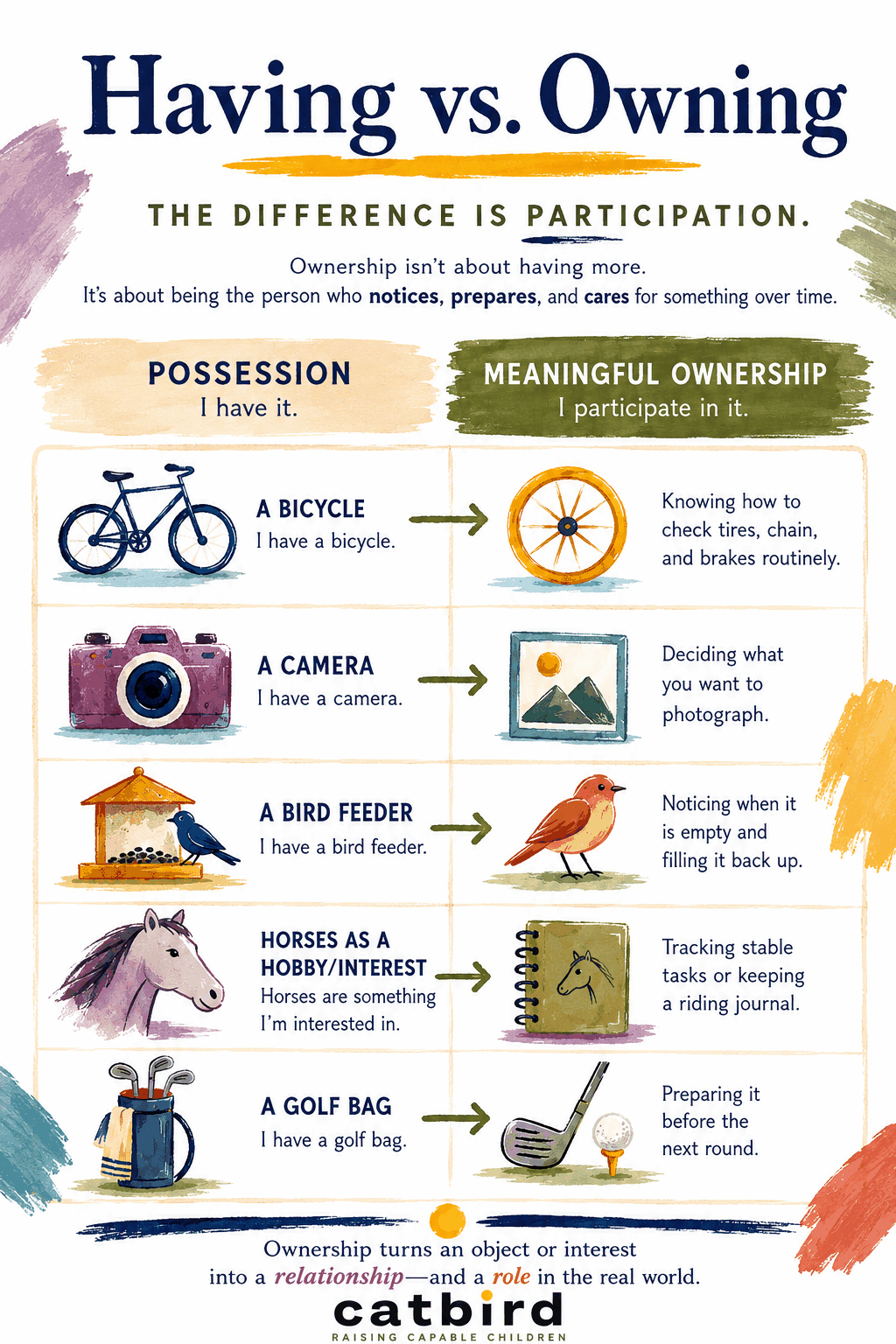
This is what ownership means at Catbird.
Ownership isn’t possession.
It isn’t another word for responsibility, either, not in the heavy, adult sense. It’s the quiet experience of becoming the person who notices what needs doing and feels capable of doing it.
When something becomes yours, different questions begin to appear.
Did I remember?
What does it need?
How could I make this better?
What should happen next?
Those questions change how children relate to the world. They stop moving through experiences someone else has prepared for them and begin shaping part of the experience themselves.
Research tells us that children develop confidence by experiencing themselves as capable. They become more motivated when they have meaningful choices and opportunities to contribute. Long before adulthood, they begin building the habits of attention, judgment, persistence, and care.
Ownership gives those habits somewhere to live.
That’s why Catbird organizes childhood around interests instead of activities.
An interest isn’t simply something to entertain. It’s a doorway into the real world.
A child captivated by horses doesn’t only need horse books. She can learn to brush the tack, recognize each horse’s personality, keep a riding journal, or prepare the barn before a lesson.
A child fascinated by space doesn’t only consume facts about the universe. He becomes the family’s astronomer: watching the night sky, planning meteor-shower evenings, recognizing the constellations as the seasons change, and reminding everyone when Saturn will be visible again.
Over time, an interest becomes a practice.
A practice becomes a relationship.
And a relationship becomes something that feels genuinely yours.
Children don’t need more to consume.
They need something to participate in.
Something to notice.
Something to maintain.
Something to improve.
Something real enough that, little by little, it becomes their own.